What is a Vehicle Identification Number?
Learn what a VIN is, why it matters, how to locate it, and how to decode it using the Auto.dev VIN Decode API.
In short
A VIN (Vehicle Identification Number) is a unique 17-character code that identifies a specific vehicle and stays constant for its entire life. It encodes the manufacturer, model, engine, model year, and assembly plant, and appears on the dashboard, driver's-side door jamb, and title. Auto.dev's VIN Decode API turns a VIN into its year, make, model, trim, engine and origin, and the Specifications and OEM Build Data APIs add specs, pricing and factory options.
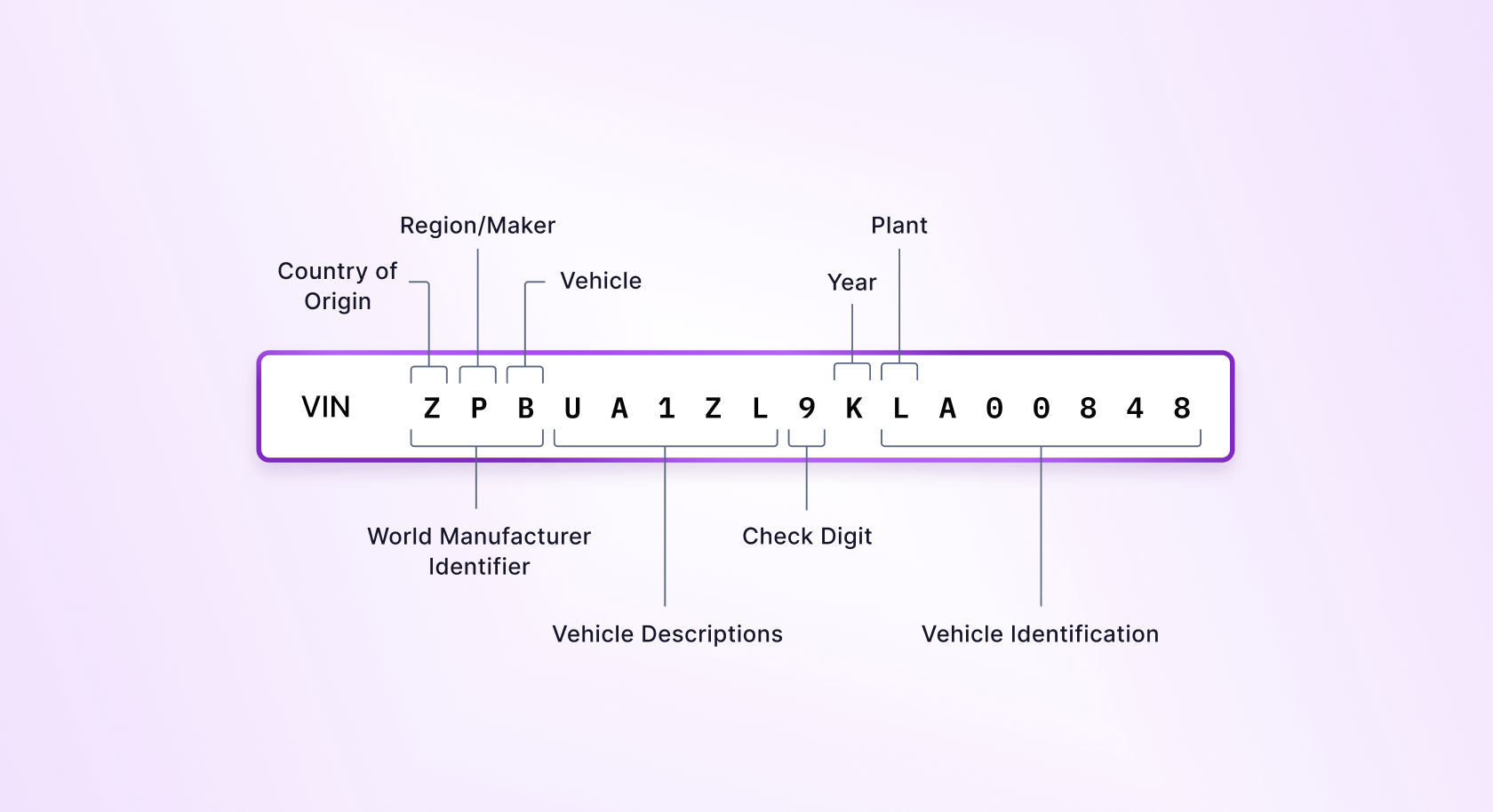
A Vehicle Identification Number (VIN) is a unique 17-character alphanumeric code used to identify individual vehicles. Unlike registration numbers that change with ownership, the VIN remains constant throughout the life of the vehicle, making it vital for vehicle history, recalls, theft prevention, and registration.
Why is the VIN Important?
- Identification: A VIN is a permanent fingerprint for every vehicle.
- Access to vehicle history: VINs unlock service, ownership, and accident records.
- Theft prevention: VINs are difficult to alter and aid in recovery.
- Safety and recall: Automakers and regulators use VINs to target recall notifications.
VIN Decode Breakdown
Example VIN: ZPBUA1ZL9KLA00848 (2019 Lamborghini Urus).
| Property | Section | Description |
|---|---|---|
ZPB | World Manufacturer Identifier (WMI) | Lamborghini's maker code. The leading Z is in the range assigned to Italy |
UA1ZL | Vehicle Descriptor Section (VDS) | Identifies model, body, engine |
9 | Check Digit | Validates the VIN |
K | Model Year | Indicates 2019 |
L | Plant Code | Factory location |
A00848 | Serial Number | Unique production sequence |
What a VIN Decode Returns
A decoder reads what the VIN encodes. Here's the response our VIN Decode API gives for a 2022 Chevrolet Silverado, from our docs' example:
{ "vin": "3GCUDHEL3NG668790", "vinValid": true, "wmi": "3GC", "origin": "Mexico", "squishVin": "3GCUDHELNG", "checkDigit": "3", "checksum": true, "make": "Chevrolet", "model": "Silverado 1500", "trim": "ZR2", "style": "4x4 4dr Crew Cab 5.8 ft. SB", "vehicle": { "year": 2022, "make": "Chevrolet", "model": "Silverado 1500", "manufacturer": "General Motors de Mexico" }}The full response also has the body, engine, drive type and transmission. Some things a VIN can't tell you, though. Paint, interior color and factory options aren't encoded in it, so they come from the manufacturer's build data instead:
| Data | Where it comes from |
|---|---|
| Year, make, model, trim, style, body, engine, drive, transmission, origin | VIN Decode, on every plan |
| MSRP and invoice, horsepower and torque, fuel economy, dimensions, warranty, features | Specifications, Growth plan |
| Factory options, paint and interior colors, options MSRP | OEM Build Data, Growth plan |
When several trims share a VIN pattern, the decoder doesn't guess. It returns trim: null and lists the candidates, most likely first.
How to Locate Your VIN on Your Vehicle
- Dashboard: Visible through the driver’s side windshield.
- Door pillar: Sticker/plate on the driver’s side door frame.
- Engine bay or frame: Stamped on the engine block or frame on some vehicles.
- Documents: Registration, title and insurance card.
Questions
Have other questions? Check out our docs or .
Where can I check a VIN for free?
NHTSA's vPIC decoder is public and costs nothing. It returns the make, model, year, body, engine and plant that manufacturers report, but not options or recalls (NHTSA's recall lookup is separate). We compared it to a paid decoder in NHTSA's VIN decoder: what it returns and where it stops. Auto.dev's VIN Decode API is included on every plan.
What happens if a VIN isn’t 17 characters long?
VINs shorter than 17 characters usually belong to vehicles built before the 1981 model year, when US federal rules first required the 17-character format. Modern vehicles must have a 17-character VIN.
Can a VIN reveal accident or service history?
Not directly. A VIN identifies the vehicle, but accident and service history comes from reporting services that tie data back to that VIN. APIs like Auto.dev focus on decoding specs and configuration.
Is the VIN format the same worldwide?
Most countries follow the ISO 3779 standard, but some regions may add local variations. The core 17-character format remains consistent for global interoperability.
Can VINs be faked or cloned?
Yes, fraudsters sometimes clone VINs from legitimate vehicles. Decoding a VIN and cross-checking against vehicle specs, plant codes, and history reports helps detect inconsistencies.
Hand this post to your agent
Copy it as Markdown, or open it in the assistant you use.




npm install -g @auto.dev/sdk